
Gobuster is one of the most essential web application reconnaissance tools in Kali Linux. It discovers hidden directories, files, DNS subdomains, and virtual hosts on target web servers through high-speed brute-force enumeration — revealing an attack surface that would never appear in a browser or sitemap.
Gobuster is a free, open-source command-line tool written in Go by OJ Reeves. It is included by default in Kali Linux and is widely used in penetration testing, bug bounty hunting, and web application security assessments. Unlike browser-based crawlers that only follow visible links, Gobuster systematically tests every word in a wordlist against a target URL and reports everything the server responds to with a valid status code.
The tool is built for speed. Because it is written in Go, Gobuster uses concurrent threads to test hundreds of paths per second — making it significantly faster than Python-based alternatives like DirBuster or dirb while producing the same quality of results.
Think of Gobuster like a librarian checking whether books exist in a library by calling out every possible title and recording which ones the librarian confirms are on the shelf. Most books are invisible on the catalogue but physically exist on the shelves. Gobuster finds every one of them by systematically asking about every possible title in a prepared list.
Gobuster modes
Mode 01: dir mode | Most used
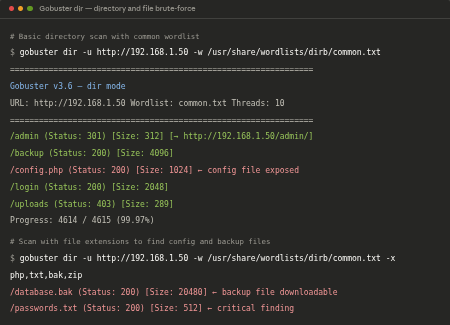
Brute-forces directories and files on a web server. Sends a GET request for every word in the wordlist and reports paths that return a non-404 response. Finds admin panels, backup files, config files, and hidden endpoints. gobuster dir -u URL -w wordlist
Mode 02: DNS mode | Subdomain recon
Brute-forces DNS subdomains by appending each wordlist entry as a subdomain to the target domain and checking whether the DNS name resolves. Reveals dev, staging, admin, and internal subdomains.
gobuster dns -d domain -w wordlist
Mode 03: vhost mode | Virtual hosting
Discovers virtual hosts on a web server by sending requests with different Host headers. Unlike DNS mode, it detects vhosts that are not registered in DNS — including internal and development sites hosted on the same IP.
gobuster vhost -u URL -w wordlist
Mode 04: fuzz mode | Parameter testing
Fuzzes any part of a URL by replacing the FUZZ keyword with each wordlist entry. Used to discover hidden parameters, API endpoints, and input fields that are not documented or visible in the application.
gobuster fuzz -u URL?FUZZ=val -w list
Gobuster practical examples


Essential Gobuster flags reference
| -u | –url | Target URL. Required for all dir, vhost, and fuzz modes. |
| -w | –wordlist | Path to the wordlist file. SecLists is the recommended wordlist collection for professional assessments. |
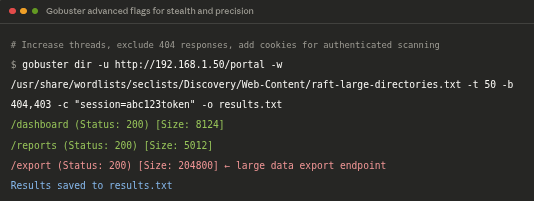
| -t | –threads | Number of concurrent threads. Default is 10. Increase to 50 for speed. Reduce to 5 for stealth on sensitive targets. |
| -x | –extensions | File extensions to test. Use -x php, txt, bak, zip to find config, backup, and script files alongside directories. |
| -b | –status-codes-blacklist | Status codes to exclude from output. Using -b 404,403 reduces noise and shows only accessible resources. |
| -c | –cookies | Session cookie for authenticated scans. Allows Gobuster to enumerate paths behind a login wall using a valid session token. |
| -o | –output | Save results to a file. Always save output during professional assessments for reporting and evidence documentation. |
| -k | –no-tls-validation | Skip TLS certificate verification. Required when scanning HTTPS targets with self-signed or expired certificates. |
The best wordlist for Gobuster directory scanning is the SecLists collection maintained by Daniel Miessler. On Kali Linux, install it with sudo apt install seclists. The file /usr/share/seclists/Discovery/Web-Content/raft-large-directories.txt contains over 62,000 directory names compiled from real web application assessments and consistently outperforms generic wordlists.
Gobuster works best in a structured workflow. Start with a quick scan using common.txt to find obvious paths in seconds. Then run a deeper scan with raft-large-directories.txt while you investigate initial findings manually. Add the -x flag with extensions relevant to the target technology stack — PHP, ASPX, JSP — to catch configuration and backup files that directory-only scans miss.
Legal requirement. Gobuster actively sends hundreds of HTTP requests per second to a target web server and is classified as active reconnaissance under computer misuse legislation. Running Gobuster against any website or web application without explicit written authorisation from the owner is illegal in most jurisdictions. All examples in this article are for authorised penetration testing engagements, lab environments, and cybersecurity education only.
Frequently asked questions about Gobuster
What is the difference between Gobuster, dirb, and Dirbuster?
All three tools perform web directory brute-forcing but differ in implementation and speed. Dirbuster is a Java-based GUI tool — feature-rich but slow and resource-heavy. dirb is a classic C-based command-line tool included in Kali Linux — reliable but single-threaded and significantly slower than modern alternatives. Gobuster is written in Go with native concurrency, making it dramatically faster than both. It supports multiple modes (dir, dns, vhost, fuzz) in a single binary, has no Java dependency, and integrates cleanly into automated assessment pipelines. For most modern penetration testing workflows, Gobuster has replaced both dirb and Dirbuster as the preferred directory enumeration tool.
How do I install Gobuster on Kali Linux?
Gobuster is pre-installed on all modern Kali Linux releases. If it is not present, install it with sudo apt update && sudo apt install gobuster. The SecLists wordlist collection — which contains the best wordlists for Gobuster — is installed separately with sudo apt install seclists. SecLists installs to /usr/share/seclists/ and provides hundreds of categorised wordlists for directory scanning, DNS enumeration, virtual host discovery, and parameter fuzzing. On other Linux systems, Gobuster can also be installed from source using Go with go install github.com/OJ/gobuster/v3@latest.
Which certifications and courses cover Gobuster?
Gobuster is a core tool in the OSCP (Offensive Security Certified Professional) curriculum — it is used extensively across the OSCP lab environment for web application enumeration and appears in many publicly shared OSCP writeups. The CompTIA PenTest+ syllabus covers directory enumeration tools, including Gobuster, within its web application testing objectives. The CEH (Certified Ethical Hacker) covers the web content discovery methodology that Gobuster implements. TryHackMe and Hack The Box both feature Gobuster prominently in their web hacking learning paths, making it one of the most commonly encountered tools for certification candidates at all levels.

