
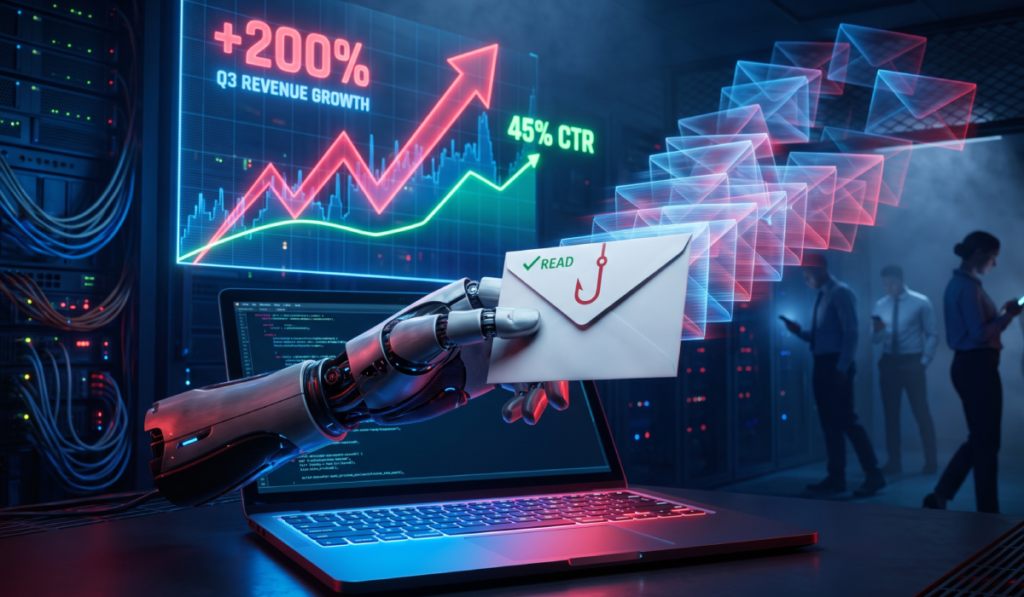
A new threat report has confirmed what cybersecurity professionals long feared: AI-generated phishing campaigns have surged by 200% over the past six months. These LLM-powered email threats are not only more numerous but also significantly more dangerous—boasting a 45% higher click-through rate than traditional human-written scams.
The report, released by Abnormal Security, analyzed billions of emails across thousands of organizations and found that threat actors are now weaponizing large language models (LLMs) like ChatGPT and open-source alternatives to craft highly convincing, grammatically flawless, and contextually relevant phishing emails at scale. This marks a paradigm shift in the phishing landscape, moving from mass, low-quality spam to precision-targeted attacks that bypass traditional security filters.
What Makes AI-Generated Phishing So Effective?
Traditional phishing emails are often riddled with spelling errors, awkward phrasing, and generic greetings—making them relatively easy to spot. AI-generated phishing campaigns, however, eliminate these red flags. Attackers feed LLMs with scraped social media profiles, corporate websites, and breached databases to produce hyper-personalized phishing attacks that mimic the tone, style, and vocabulary of real colleagues or trusted vendors.
For example, an AI-generated email can reference ongoing projects, use internal jargon, and even mimic a manager’s writing style—all without human intervention. This level of ChatGPT social engineering makes it extraordinarily difficult for employees to distinguish legitimate correspondence from malicious attempts.
The Automation Advantage for Attackers
The 200% increase is directly attributed to automation. Cybercriminals are now using AI-powered tools to:
- Generate thousands of unique phishing templates in minutes.
- Automatically scrape LinkedIn and company websites for employee names, roles, and reporting structures.
- Craft individualized emails that reference specific business activities.
- A/B test subject lines and body content to maximize open and click rates.
This has effectively democratized sophisticated phishing. Even low-skilled attackers can now launch automated spear-phishing tools that rival nation-state capabilities. The result is a massive volume of AI-driven social engineering attacks that overwhelm traditional email security gateways.
Why Traditional Email Security Fails Against AI Threats
Legacy email filters rely on signature-based detection and reputation scoring. These methods are powerless against AI-generated phishing campaigns because each email is structurally unique and originates from legitimate, compromised email accounts. There is no malicious payload, no suspicious link pattern, and no recognizable malware signature—just a perfectly crafted text that manipulates human psychology.
Furthermore, attackers are using AI fraud detection bypass techniques, such as:
- Inserting benign-looking URLs that redirect only after the email lands in the inbox.
- Using markdown and rich text features to evade text-based scanners.
- Mimicking internal reply-chain threads to appear legitimate.
Behavioral Analysis and Zero-Trust Email Security as the Solution
To combat this rising threat, organizations must shift toward zero-trust email security and behavioral analysis. Unlike legacy tools, modern platforms analyze:
- Sender reputation and behavior history – Does this sender typically email at 2 AM from a foreign IP?
- Emotional and linguistic patterns – Does the email’s tone match previous communications from this person?
- Contextual anomalies – Is the request unusual for this employee’s role?
By creating a baseline of normal communication patterns, AI-driven security tools can flag anomalies that indicate LLM email impersonation, even when the email contains no overtly malicious content.
Strengthening Human Defense Through AI Security Awareness Training
Technology alone cannot solve this problem. Organizations must invest in AI security awareness training that educates employees specifically about AI threats. Traditional “spot the typo” training is now obsolete. Instead, training should focus on:
- Verifying unusual requests through out-of-band channels (e.g., phone or in-person).
- Recognizing emotional manipulation tactics, even in well-written emails.
- Questioning urgency and authority—two psychological triggers heavily exploited by AI-generated phishing campaigns.
Simulated attacks powered by the same generative AI attack vectors can help employees build practical immunity against these threats.
The Bottom Line
The 200% increase in AI-generated phishing campaigns is not a temporary spike—it is the new normal. Attackers now possess the tools to execute hyper-personalized phishing attacks at machine speed. Defending against this requires a layered approach: AI-powered email filters, continuous behavioral monitoring, and adaptive security awareness training.
The question is no longer if your organization will face an AI-driven social engineering attack, but when. Prepare now before your employees become the next statistic.

