
Post-exploitation is the phase of a penetration test that begins the moment a successful compromise is achieved. It is where an ethical hacker demonstrates the true business impact of a vulnerability — showing not just that a system can be accessed, but what an attacker could realistically do once inside. This phase is what transforms a penetration test from a technical exercise into a meaningful risk assessment for the client.
In ethical hacking, post-exploitation follows the successful delivery of a payload and the opening of an active session on a compromised host. The goal is to systematically explore the extent of access achieved — gathering system intelligence, assessing privilege levels, identifying sensitive data, testing the ability to move to other systems, and documenting all findings with evidence for the final penetration test report.
Understanding post-exploitation from both the attacker and defender perspectives is critical for any security professional. For penetration testers, it demonstrates real impact. For defenders, it shows exactly what to detect and prevent after an initial compromise occurs in a real incident.
Think of post exploitation like a building inspector who has just been given the key to one room. Their job is not to cause damage — it is to document what could be accessed from that room: which other doors it connects to, what files are stored there, whether the master key is hanging on the wall, and how deep into the building an intruder could realistically go. The inspector documents everything and hands the report to the building owner to fix.
The six phases of post-exploitation
Phase 01: System enumeration (First step)
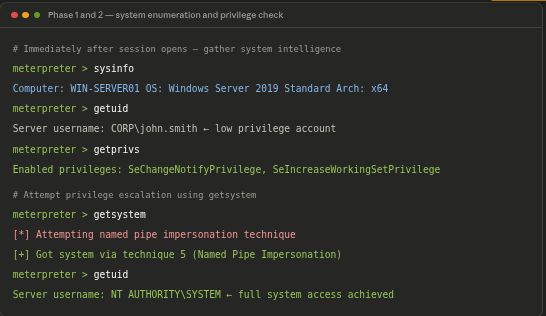
Gathering full system intelligence immediately after gaining access — OS version, hostname, installed software, running processes, active network connections, and logged-on users. This baseline data shapes all subsequent decisions.
Phase 02: Privilege escalation (Expand access)
Elevating from a limited user account to administrator or SYSTEM-level privileges. Techniques include exploiting misconfigured services, unquoted service paths, SUID binaries, kernel vulnerabilities, and weak sudo rules.
Phase 03: Credential harvesting (High-value data)
Extracting stored credentials from the compromised system — password hashes from SAM and SYSTEM files on Windows, plaintext credentials from memory, SSH keys, browser-saved passwords, and application configuration files.
Phase 04: Lateral movement (Network spread)
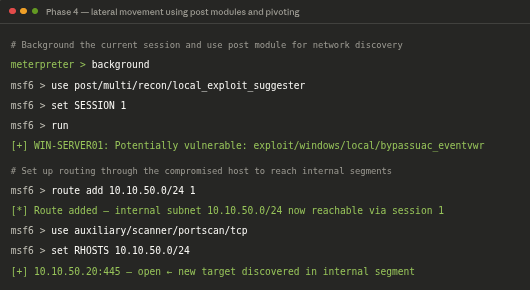
Using credentials and access from the compromised host to authenticate to and compromise additional systems in the same network. Demonstrates how far an attacker could realistically spread from a single initial foothold.
Phase 05: Data identification (Business impact)
Locating sensitive data on the compromised system — configuration files, database credentials, customer records, financial documents, and intellectual property — to demonstrate the real business impact of the compromise to the client.
Phase 06: Evidence collection (Reporting)
Capturing screenshots, recording session logs, and saving command outputs as evidence for the penetration test report. Every finding must be supported by reproducible evidence that demonstrates impact on the client and their board.
Post-exploitation practical examples with Meterpreter

Defensive measures against post-exploitation techniques
Post-exploitation technique and corresponding defence
| Privilege escalation | Apply the principle of least privilege — users should only have the permissions their role requires. Keep operating systems and software fully patched to remove known local privilege escalation vulnerabilities. Disable SUID binaries that are not operationally required on Linux systems. |
| Credential harvesting | Enable Windows Credential Guard to protect LSASS memory from credential dumping. Enforce multi-factor authentication so harvested password hashes and plaintext credentials cannot be used alone. Implement tiered administrator accounts that are never used on standard workstations. |
| Lateral movement | Implement network segmentation with strict firewall rules between internal subnets. Deploy a privileged access workstation strategy. Restrict administrative shares and disable unnecessary remote management protocols such as WMI and WinRM on non-administrative systems. |
| Persistence mechanisms | Monitor Windows registry run keys, scheduled tasks, and startup folder entries for unauthorised changes. Deploy EDR solutions that alert on suspicious process creation, service installation, and new scheduled task registration. Review SSHD authorised keys files regularly on Linux. |
| In-memory malware | Deploy behavioural-based EDR solutions that detect anomalous process behaviour rather than relying on file signatures. Enable memory integrity protection. Monitor for processes injecting into other process memory spaces using Windows Defender Credential Guard and Attack Surface Reduction rules. |
The most important post exploitation deliverable in a professional engagement is not the credentials extracted or the systems reached — it is the evidence-backed narrative of business impact. A penetration test report that says “we achieved SYSTEM-level access on the domain controller and could have accessed all 47,000 customer records” is infinitely more valuable to a client than a list of CVEs. Post exploitation evidence — screenshots, session logs, and file listings — is what makes that narrative credible and compelling to non-technical stakeholders.
For defenders and blue teams. Post exploitation techniques are exactly what incident responders look for when investigating a breach. Understanding how privilege escalation, credential harvesting, and lateral movement work in practice makes blue team analysts significantly more effective at identifying attacker activity in SIEM logs, EDR alerts, and network traffic. Every blue team member benefits from understanding post exploitation techniques from the attacker perspective.
Legal and ethical requirement. Every post exploitation technique described in this guide involves active interaction with a compromised system. All of these activities must be performed exclusively within the scope defined in a signed penetration testing agreement on systems the client has explicitly authorised for testing. Performing post exploitation activities on any system without written authorisation constitutes unauthorised computer access and is illegal under computer misuse legislation globally.
Frequently asked questions about post-exploitation
What is the difference between post-exploitation and persistence in penetration testing?
Post exploitation is the broad phase that encompasses everything an ethical hacker does after gaining initial access — system enumeration, privilege escalation, credential harvesting, lateral movement, and evidence collection. Persistence is one specific technique within post-exploitation where the attacker establishes a mechanism to maintain access across reboots and session terminations — such as adding a registry run key, creating a scheduled task, or adding an SSH public key to an authorised keys file. In professional penetration testing, persistence is typically demonstrated as a proof of concept and then cleaned up before the engagement ends, with all persistence mechanisms documented in the report for the client to review and remediate.
What is pivoting in post-exploitation and why does it matter?
Pivoting is the technique of using a compromised host as a relay point to reach and attack other systems in network segments that are not directly accessible from the attacker’s machine. For example, a web server in the DMZ may have access to the internal database network that is firewalled from the Internet. By establishing a route through a session on the web server using Metasploit’s route add command or a SOCKS proxy, the attacker can scan and attack the internal database network through the compromised web server. Pivoting is critically important in penetration testing because it demonstrates how a single exposed system can become a gateway into the entire internal network, which is how most real-world breaches escalate from a single compromise to a full network takeover.
Which certifications test post-exploitation skills in depth?
Post-exploitation is a central component of the OSCP (Offensive Security Certified Professional) — the 24-hour exam requires candidates to demonstrate privilege escalation and thorough post-exploitation evidence collection on multiple machines. The CEH (Certified Ethical Hacker) covers post-exploitation phases, including privilege escalation, credential harvesting, and persistence in its system hacking module. The CRTE (Certified Red Team Expert) and CRTO (Certified Red Team Operator) focus specifically on advanced post-exploitation in Active Directory environments. CompTIA PenTest+ tests post-exploitation methodology within its exploitation and reporting objectives. The eWPT and eCPPT from eLearnSecurity also include comprehensive post-exploitation lab exercises.

